In a nutshell
- 🍳 The spoon crack creates controlled microfractures that protect the white and target the membrane, making shells lift off in broad sheets.
- 🥄 Follow the 10‑second method: tap the wide end to pop the cap, slide the spoon under the air cell, then rotate for a smooth, guided peel.
- 🧪 Science matters: rising pH in 7–10 day‑old eggs, quick set from hot‑start cooking, and the membrane’s elasticity enable fast, clean separation.
- ❄️ Use an ice bath after boiling; thermal shock contracts proteins, reduces adhesion, and speeds peeling with fewer nicks and pits.
- ⏱️ Compared with rolling or jar shaking, the spoon offers superior force control, less risk to the white, and presentation‑ready results every time.
Peeling a hard‑boiled egg shouldn’t feel like archaeology. It can be swift, clean, oddly satisfying. The simplest upgrade is also the most counterintuitive: use a spoon, not the worktop. By tapping with a curved bowl of metal and then sliding its edge between shell and membrane, you create a controlled release that finishes in seconds, not minutes. Minimal mess, maximum control. The trick sits at the intersection of kitchen physics and newsroom pragmatism: targeted force, smart leverage, a bit of water, and the egg’s own structure. Start at the wide end where the air cell lives, and you’re already halfway to breakfast.
Why the Spoon Crack Works
A chicken egg isn’t a marble. It’s a layered system: outer shell, inner shell membranes, albumen, yolk. The secret to painless peeling is not pulverising the shell but delaminating the membrane that clings to the white. A spoon outperforms a countertop because its curved surface concentrates contact yet spreads force across a small arc. That duality matters. The tap triggers a lattice of microfractures that stop at the membrane; the rounded profile avoids gouging the white, unlike flat, blunt strikes that shove shards inward.
Target the wide end first. There’s an air cell there—your entry point. A gentle, decisive tap pops a “cap,” creating space to slide the spoon’s rim beneath the shell. As you rotate the egg, the spoon’s curvature mirrors the egg’s own, acting like a cam that lifts shell away in sheets. Add a dribble of water and you get a tiny hydraulic assist. Moisture seeps between layers, reducing adhesion through capillary action and light suction release.
Physics does the heavy lifting. Acoustic energy from the tap travels through the brittle calcium carbonate shell, creating a network of cracks, while the more elastic membrane arrests their depth. Cracking with a spoon targets the membrane, not the white, and that’s why the peel comes off fast—often in one or two broad ribbons.
Step‑By‑Step: The 10‑Second Method
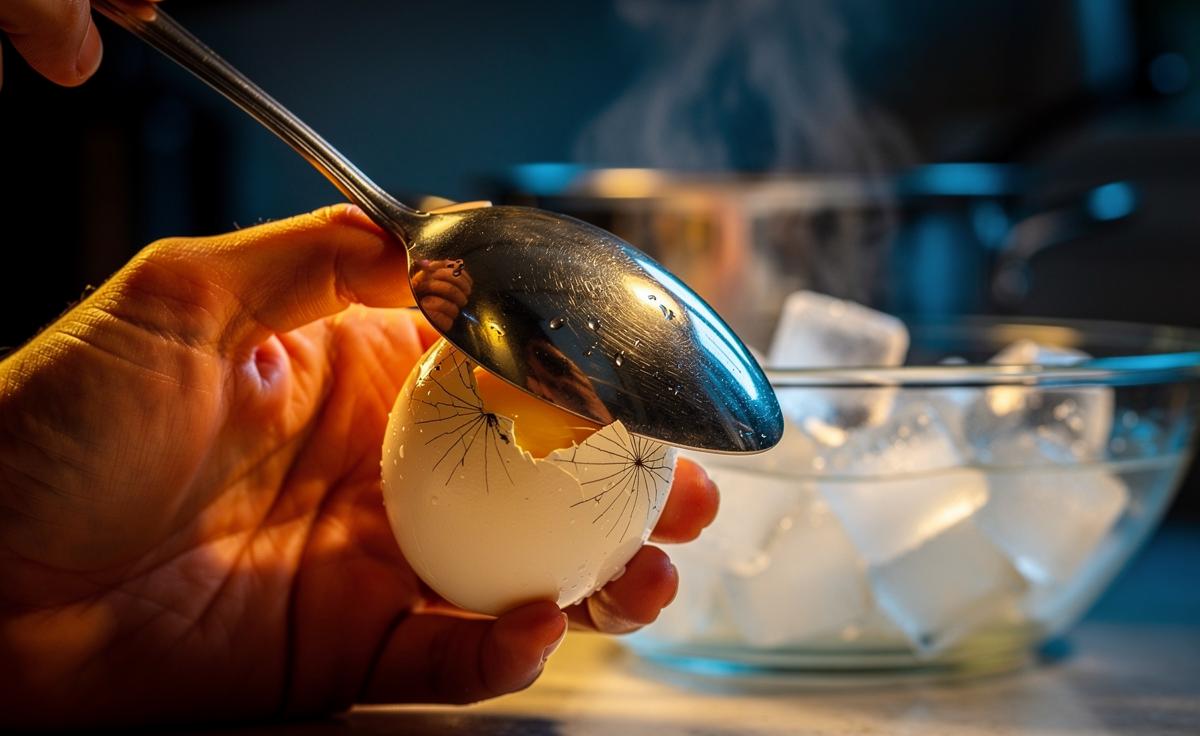
Chill the eggs first. Five minutes in an ice bath or cold running water is enough to contract the white slightly and firm the membrane. Hold a cooled egg in your non‑dominant hand, wide end pointing up. With a teaspoon, give one clean tap to the crown. You want a circular fissure, not a spiderweb. Rotate and tap again if needed to create a thumb‑sized cap. Peel off that cap to expose the membrane and the pocket of air waiting beneath.
Now the glide. Slide the spoon’s rim under the membrane at the edge of the opening, maintaining a shallow angle. Keep light pressure and rotate the egg against the spoon—not the other way around. The bowl of the spoon hugs the egg’s curve, lifting shell segments in smooth plates. Where you meet resistance, back off a centimetre and re‑enter at a new angle. A trickle of water under the shell helps; it lubricates and lifts micro‑shards.
Work around the equator, then up to the pointed end. Most shells will come away in two arcs. If an egg is unusually clingy, pinch the membrane with your thumb to “lead” the peel while the spoon follows. From first tap to clean egg, 10 seconds is realistic. Rinse to remove stray flakes. Pat dry. Admire the glossy, unpitted white you didn’t sacrifice to impatience.
Science and Variables That Affect Peelability
Not all eggs behave alike. Freshness is the biggest variable. A just‑laid egg has a lower pH, a tight albumen, and a clingy membrane—doom for easy peeling. After a week in the fridge, carbon dioxide diffuses out, the pH rises, and the inner membrane loosens its grip. Aim for eggs that are 7–10 days old for best results. Cooking method counts too: steaming or starting in boiling water sets the outer white quickly, reducing bonding to the membrane compared with a slow cold‑start.
Thermal shock is your ally. Chill immediately in an ice bath to contract proteins and encourage a clean separation. Salt and baking soda? Marginal. They may nudge pH or boiling dynamics but won’t beat technique. Altitude and shell thickness matter—harder waters and older hens can yield tougher shells. When in doubt, lean on the spoon’s leverage and the wide‑end entry to compensate for the variables you can’t control.
The membrane is the battlefield; learn to separate it, and the shell surrenders. Combine age, hot‑start cooking, rapid chilling, and the spoon crack, and you’ll stack the odds heavily in your favour.
Comparing Peeling Techniques at a Glance
Home cooks swear by rolling, shaking, even blowing. Some work, some bruise the white, some spray shell confetti everywhere. The spoon crack stands out because it couples force control with guided separation. You decide where to fracture, then you drive a smooth metal wedge between layers. No jars, no drama, no rough abrasion. For batch peeling, it’s consistent; for a single egg on toast, it’s quick. The table below summarises the trade‑offs that matter when time and presentation both count.
| Method | Force Control | Membrane Separation | Typical Time | Risk to White | Best Use |
|---|---|---|---|---|---|
| Spoon Crack | High, targeted | Excellent with entry at air cell | ~10 seconds | Low | Everyday, presentation‑worthy eggs |
| Countertop Rolling | Moderate, diffuse | Inconsistent | 20–40 seconds | Medium | Quick, casual peeling |
| Jar Shake | Low, chaotic | Variable | 10–30 seconds | High | Multiple eggs, not for show |
| Water Under Shell | Moderate | Good with practice | 15–30 seconds | Low–Medium | Stubborn shells, sink rinse |
Notice what wins: precision. The spoon’s curvature allows a guided peel that protects the albumen, keeps your hands clean, and avoids the ugly pitting that ruins devilled eggs. Rolling and shaking can be fast, but they sacrifice neatness. Water injection helps, yet it still needs an entry point—the spoon gives you that every time. If you care about speed and a smooth finish, the spoon is the gold standard. For beginners and batch cookers alike, it’s an easy habit with outsized returns.
Peeling shouldn’t be guesswork. By exploiting the egg’s structure, the physics of brittle shells, and the leverage of a humble teaspoon, you turn a fiddly job into a tidy, repeatable move. Start at the wide end, lift the cap, slip the spoon, rotate, rinse. The result is a clean white that takes salt, mayo, or soy beautifully and a kitchen that doesn’t look like a shell storm hit it. Ready to retire the countertop bash and try the 10‑second spoon crack—what will you peel first, and how will you time yourself?
Did you like it?4.7/5 (21)