In a nutshell
- 🍌 Buried banana peels decompose fast and release potassium, phosphorus, and calcium directly in the root zone, with visible benefits in about two weeks.
- ⏱️ The timeline: days 0–3 microbial colonisation, 4–7 fibres break down and K mobilises, 8–14 peak nutrient trickle—faster in warm, moist, well-aerated soil with 1–2 cm pieces.
- 🌱 How-to: chop and bury 5–10 cm deep, 10–15 cm from stems; use one peel per 30–40 cm of row or per 8–10 L pot, then water to kick-start microbial activity.
- ⚖️ Balance and safety: peels are high in potassium but low in nitrogen—pair with a light N source; always bury to prevent pests, odours, and nutrient runoff; avoid soggy, airless pockets.
- 🌹 Best use and caveats: great for flowering/fruiting plants (tomatoes, peppers, roses); treat as a supplement, not a complete feed; distribute widely, cover well, and track growth to fine-tune doses.
Gardeners love quick wins. Few are as simple as burying a banana peel beneath the soil to give hungry plants a natural lift. It’s kitchen scrap alchemy. Within a fortnight the peel softens, breaks down, and begins releasing a gentle flush of potassium, phosphorus, and calcium right where roots can use them. Done thoughtfully, this micro-dose of nutrients boosts flowering, fruiting, and overall resilience without the hard edge of synthetic feeds. No compost bin? No problem. Your border or pot becomes the processing plant, led by soil microbes already on the scene. Here’s why it works—and how to make that two-week promise real.
Why Buried Banana Peels Feed Plants Fast
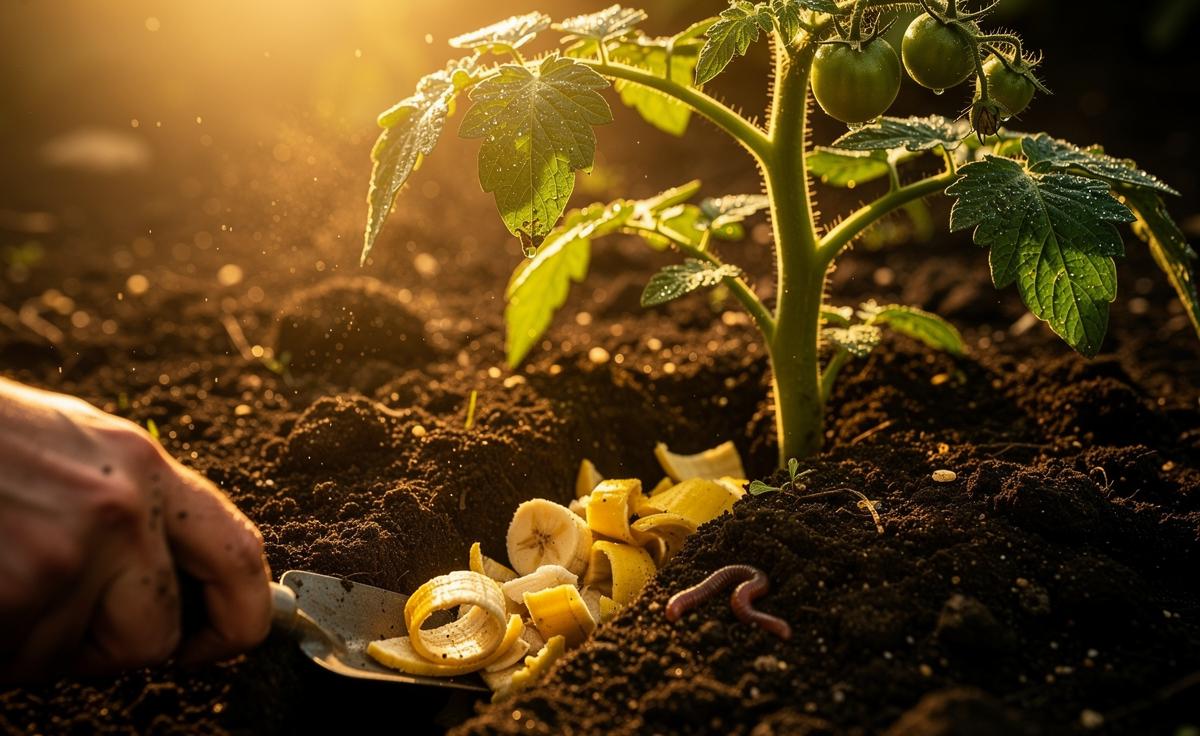
The secret lies in surface area, soil contact, and a rush of microbial activity. Banana peels carry readily digestible sugars that act like a starter pistol for bacteria and fungi. Chop the peel into small pieces, bury it 5–10 cm deep, and the soil life responds. That close contact stops the peel from drying out, speeds colonisation, and keeps the chemistry happening exactly in the root zone. In warm, evenly moist soil, microbes chew through the soft tissues quickly, loosening cell walls and freeing soluble potassium, a central player in water regulation, disease tolerance, and bloom quality.
There’s a second benefit. Because the peel is underground, nutrients don’t wash away with the first shower or attract pests at the surface. Instead, the rhizosphere—those few millimetres of soil around roots—captures the trickle. Roots don’t have to chase it. They sip it. The result is a modest but timely pulse of nutrition that plants can fold into new growth within roughly two weeks. It’s not a full feed, but it is a targeted nudge, and for flowering crops that nudge often shows up as stronger buds and steadier colour.
From Peel to Plant: The Two-Week Timeline
Timelines depend on temperature, moisture, and how finely you chop the peel, but the broad pattern is consistent. Early on, bacteria bloom on the sugary surfaces. Then fungi thread through the peel matrix, unlocking bound minerals. As fibres soften, earthworms drag fragments deeper, mixing the peel into the soil profile. With decent conditions, usable potassium begins trickling into the root zone in about 10–14 days. The table below maps the typical progression so you can set expectations and spot when things are on track.
| Days | Process | What Plants Get |
|---|---|---|
| 0–3 | Microbes colonise sugars; peel softens | Minimal nutrients; microbial priming |
| 4–7 | Fungal breakdown of fibres; worm activity begins | Potassium starts to mobilise; small amounts of phosphorus |
| 8–14 | Peak decomposition in warm, moist soil | Steadier K trickle; calcium and magnesium become available |
Chilled soils slow everything; waterlogged beds do too. Aim for crumbly, moist—not soggy—conditions. Chop pieces to 1–2 cm for faster action, and don’t stack too many peels in one spot. Distribute them thinly to avoid a slimy, airless pocket that stalls decay. If nights are cool, expect the curve to stretch; the nutrients will still arrive, just later. In containers, work small amounts into the top layer and cover well to prevent gnats or odours. The principle is simple: maximise contact, minimise clumping, keep oxygen flowing.
How to Use Banana Peels Safely and Effectively
Start clean: remove labels and any plastic, then chop the peel. Dig a narrow slit 10–15 cm from the plant stem (or around the drip line for shrubs), 5–10 cm deep. Tuck the peel pieces in and backfill firmly. Keep direct contact with stems to a minimum to reduce rot risk on tender annuals and seedlings. One medium peel per 30–40 cm of row, or per 8–10 litre pot, is a sensible guide. For heavy feeders in peak bloom, repeat every three to four weeks in small, even doses.
Balance matters. Banana peels are rich in potassium but relatively low in nitrogen. If leaves look pale, pair peels with a mild nitrogen source—well-rotted compost, alfalfa pellets, or a light application of organic fertiliser—so growth doesn’t stall. In dry spells, water after burying to kick-start microbial activity. In wet spells, raise the bed or improve drainage to avoid anaerobic pockets. Burying is better than blending into “banana water”, which often ferments and smells before roots can use it. For indoor plants, go sparingly and cover thoroughly; a tidy soil cap stops fungus gnats from finding the feast.
Plants That Benefit and Practical Caveats
Think in terms of need. Crops that flower and fruit heavily—tomatoes, peppers, chillies, roses, cucumbers, courgettes—respond well to a gentle potassium lift that steadies bloom and fruit fill. Root crops appreciate the calcium and magnesium for tissue strength. Perennials and shrubs benefit from slow, local enrichment, especially when soil is already reasonably fertile. If your soil is poor overall, treat peels as a supplement, not a substitute for full-spectrum compost or balanced fertiliser.
Caveats are straightforward. Don’t dump a mound of peels in one hole; distribute them to avoid attracting rodents and to keep decay aerobic. Avoid waterlogged spots where peels turn slimy. If you’re mulching thickly with wood chips, place peels just below the mulch-soil interface so microbes can access both carbon and peel sugars. In no-dig beds, slide a trowel to open a slit and close it neatly; you’re feeding life, not disturbing it. Measure results: watch for firmer stems, cleaner leaf edges, and steadier flowering over three to four weeks. Then adjust the dose, up or down.
Banana peels won’t replace a well-made compost heap, but they shine as a quick, localised boost that costs nothing and wastes nothing. Bury them chopped, spaced, and covered, and you can expect a usable pulse of potassium within about two weeks under average garden conditions. That’s smart gardening—small inputs, visible gains. Ready to test it? Which plant in your patch will be the first to trial a buried peel, and how will you track the difference across the next month?
Did you like it?4.6/5 (28)