In a nutshell
- 🔥 Heat from boiling water causes protein denaturation, membrane rupture, and tissue collapse, acting like a contact herbicide; annuals die quickly while deep-rooted perennials may need repeat treatments.
- 🧭 Works best on patios, block paving, and gravel; avoid lawns and lush beds; time applications for seedling flushes and aim the pour at the root crown to maximise kill.
- 🫗 Technique: boil, pour low (5–10 cm), use a slow, steady stream targeting the crown and cracks; Safety: wear gloves and long trousers, keep pets/children away, and shield nearby ornamentals.
- 💷 Low-cost and green—no residue; contrasts with vinegar (leaf burn only), systemic herbicides (deeper control but regulation/runoff concerns), and hand weeding (precise yet time-heavy).
- ♻️ Smart strategy: remove dead foliage, re-treat tough perennials within 7–10 days, and combine methods for season-long, chemical-free control on hard surfaces.
Weeds love British cracks and corners. Garden paths, block-paved drives, gravel strips along fences: all prime territory. There’s a quick, chemical-free fix hiding in plain sight—your kettle. Applying boiling water delivers immediate results, collapsing soft tissues and shutting down growth in minutes. It’s clean, fast, and oddly satisfying. Not magic, though. Understanding how heat works lets you use it smarter, avoid collateral damage, and decide when it’s worth repeating. This guide explains the science, the practical technique, and the trade-offs, so you can scorch unwanted plants with confidence while keeping the rest of your garden safe.
How Heat Stops Weed Growth Instantly
Heat kills weeds by unleashing a cascade of failures. At around 70–100°C, protein denaturation unravels enzymes vital to photosynthesis and respiration. Cell membranes rupture, water floods out, and tissues collapse. The thin-walled vessels that move sap—xylem and phloem—are damaged, starving the top growth. Crucially, the meristem (the plant’s growth engine) at the crown and nodes is cooked, so shoots can’t rebound. Leaves blanche, then turn limp. Within hours, you’ll see a definitive slump.
Yet not all weeds die equally. Annuals and small taproots succumb at once. Fibrous perennials often need a second hit because insulated roots can survive below the scald zone. That’s why the technique works brilliantly on seedlings in paving but may need repeating for deep-rooted stalwarts like dandelions and plantain. Think of boiling water as a contact herbicide powered by physics: no residue, instant impact, and minimal drift when poured precisely.
Where Boiling Water Works Best
Target hard landscaping. Patios, block paving, gravel drives, brick steps, kerb edges, and fence lines offer clean access to the crown, and the heat doesn’t harm soil biology much because it cools quickly. Moss and algae on slabs also wilt, improving grip. On bare soil, it’s effective against small flushes, especially after rain when seedlings are tender. Avoid lush beds: the splash can scald perennials. Never pour boiling water across lawns you want to keep. Grass will yellow and thin, leaving a patchy scar.
Timing matters. Treat after a dry spell for crisper kills, or strike young growth right after germination waves in spring and late summer. Choose still days. Wind increases splash risk. On deep-rooted perennials sprouting from cracks, tilt the pour to reach the root crown. If regrowth appears, repeat within 7–10 days before the plant rebuilds reserves and hardens off.
Step-by-Step Method and Safety Essentials
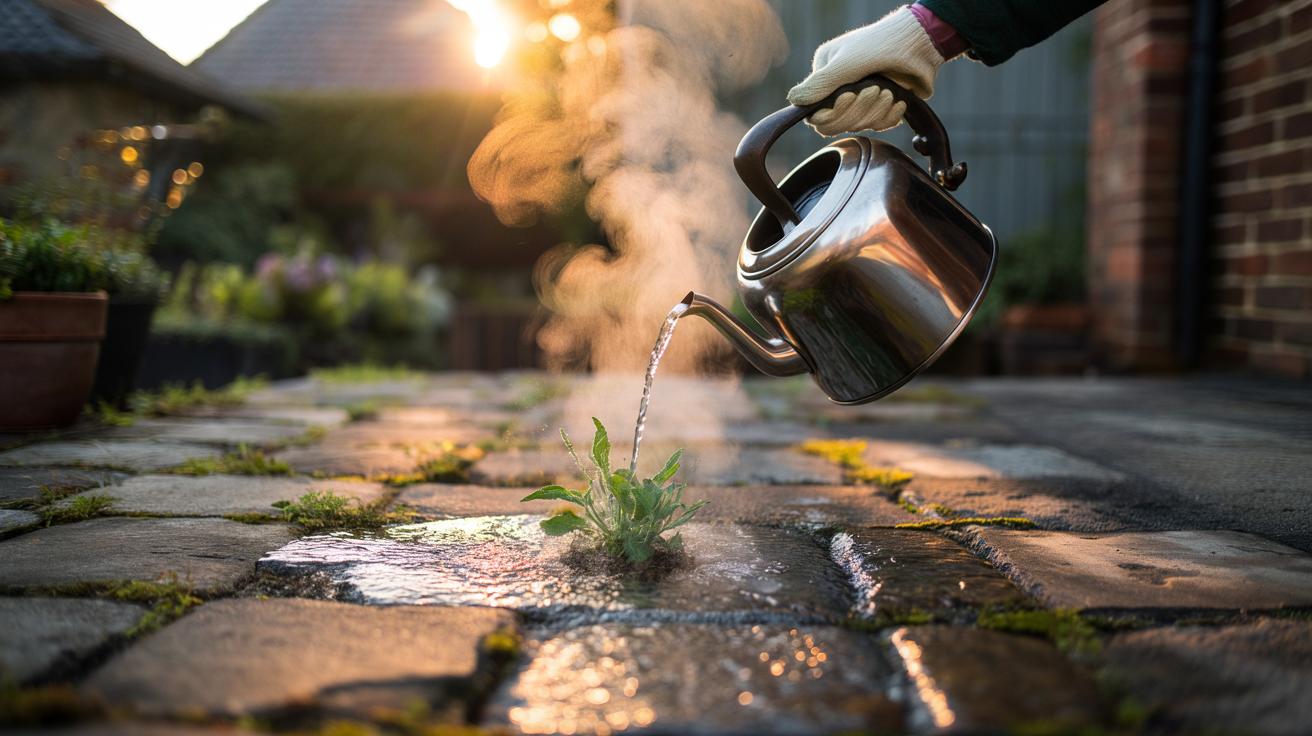
Boil a full kettle. Work in sections you can reach without rushing. Start close to the weed. Pour from a low height—5–10 cm above the target—to focus heat and prevent splashes. A steady, slow stream is best. Aim for the crown first, then trace the stem base and any visible runners. For clusters, spiral outward to avoid stepping back through hot water. Where plants hide in narrow joints, angle the spout into the crack to carry heat down.
Safety first. Wear gloves, long trousers, and closed shoes. Keep pets and children away for 10 minutes. Use a heatproof jug outdoors; don’t walk through the house with a boiling kettle if avoidable. Shield nearby ornamentals with a board or upturned bucket. Don’t use on fresh tarmac or near fragile render. If the area is near utilities or wiring conduits, avoid flooding—heat won’t harm plastic ducts, but sudden expansion could stress brittle covers. Expect to re-treat tough perennials once or twice; remove dead foliage to expose any survivors.
Comparing Costs and Environmental Impact
Boiling water is frugal and green if your energy use is sensible. You’re paying for heat, not a bottle. There’s no chemical residue, no drift to hedges, and no need to store anything hazardous. The trade-off is labour and kettle cycles. Vinegar “kills” are often cosmetic—low-strength acetic acid burns leaves but spares roots—while synthetic herbicides deliver systemic control yet come with application rules, runoff risks, and public perception concerns. Hand weeding is precise but time-heavy. Choose the tool that fits your surface, weed type, and calendar.
| Method | Upfront Cost | Control Depth | Regrowth Risk | Runoff/Residue |
|---|---|---|---|---|
| Boiling Water | Low (kettle energy) | Crown-level | Medium on perennials | None |
| Vinegar Sprays | Low–Medium | Leaf-only | High | Low–Medium |
| Hand Weeding | Low tools | Root if extracted | Low if thorough | None |
| Systemic Herbicide | Medium | Whole plant | Low | Possible |
Used well, boiling water is a sharp, sustainable tactic for hard surfaces and young weeds, cutting through growth without adding chemicals to your plot. It won’t replace every tool in your shed, but it fills a crucial gap: fast, tidy control where precision matters. Start small, pour low, and watch the wilt set in. Then decide if a second pass is warranted. Ready to reclaim your paving and paths—kettle in hand—or will you mix methods to match the season and the weeds you face? What’s your plan for the next flush?
Did you like it?4.6/5 (26)