In a nutshell
- 🛑 Pain is not progress: distinguish sharp, lingering, or nerve-like sensations from healthy effort, and stop if you must hold your breath.
- 🧭 Fix alignment in key poses: in Downward Dog distribute weight and bend knees; in Plank lift thighs and knit ribs; in Warrior II track the knee over toes; micro-bend in forward folds.
- 🌬️ Let breath lead: avoid breath-holding; apply light bandha engagement (20–30%) to stabilise without gripping, and reduce depth if the breath chases the movement.
- 🧱 Use smart props and modifications: blocks, straps, and blankets protect wrists, knees, and hamstrings—elevate the floor and adapt to daily variability for safer consistency.
- 🧑🏫 Seek guidance and self-assess: consult a teacher for recurring pain, film poses to spot patterns, log sensations, and see a healthcare professional for red-flag symptoms.
Yoga should feel like a conversation with your body, not a legal dispute. Yet too many enthusiasts in studios and living rooms across the UK mistake grit for grace, or Instagram geometry for safe alignment. Small errors compound. A twinge today becomes a stubborn ache by Friday. The fix isn’t abandoning your mat; it’s learning to listen, refine, and adjust. In this guide, you’ll spot the telltale signals that your practice is sliding off course, and learn how to steer it back. Pay attention to pain that is sharp, electric, or persists after class. That is not growth. That is your body requesting a change of plan.
Pain Is Not Progress: Recognise Red Flags
Not all discomfort is equal. The gentle burn of effort differs wildly from pain that bites. Sharp, stabbing, or tingling sensations demand an immediate stop. So does lingering soreness in the wrists, knees, and lumbar spine that fails to fade after rest. Numbness? A red flag for nerve irritation. If you need to hold your breath to endure a pose, the pose is wrong for you right now. There’s bravery in stepping back, especially when a teacher tells the room to “go deeper”. Deeper into what, precisely?
Track patterns. Does downward dog always spark shoulder burn at the top of the arms? Do hip openers leave your groin feeling bruised? These are clues. Pain localised at joint lines signals load transferred to passive tissues instead of supporting musculature. Translation: your alignment, pacing, or ego is doing the heavy lifting. Refine one variable at a time—angle, stance width, or prop choice.
Finally, notice the afterglow. A safe practice leaves you clear, warm, and tall. Any session that routinely ends with you limping to the kettle needs rethinking. Progress looks like consistency, not heroics, and your nervous system votes with sensations, not Instagram likes.
Common Alignment Errors in Popular Poses
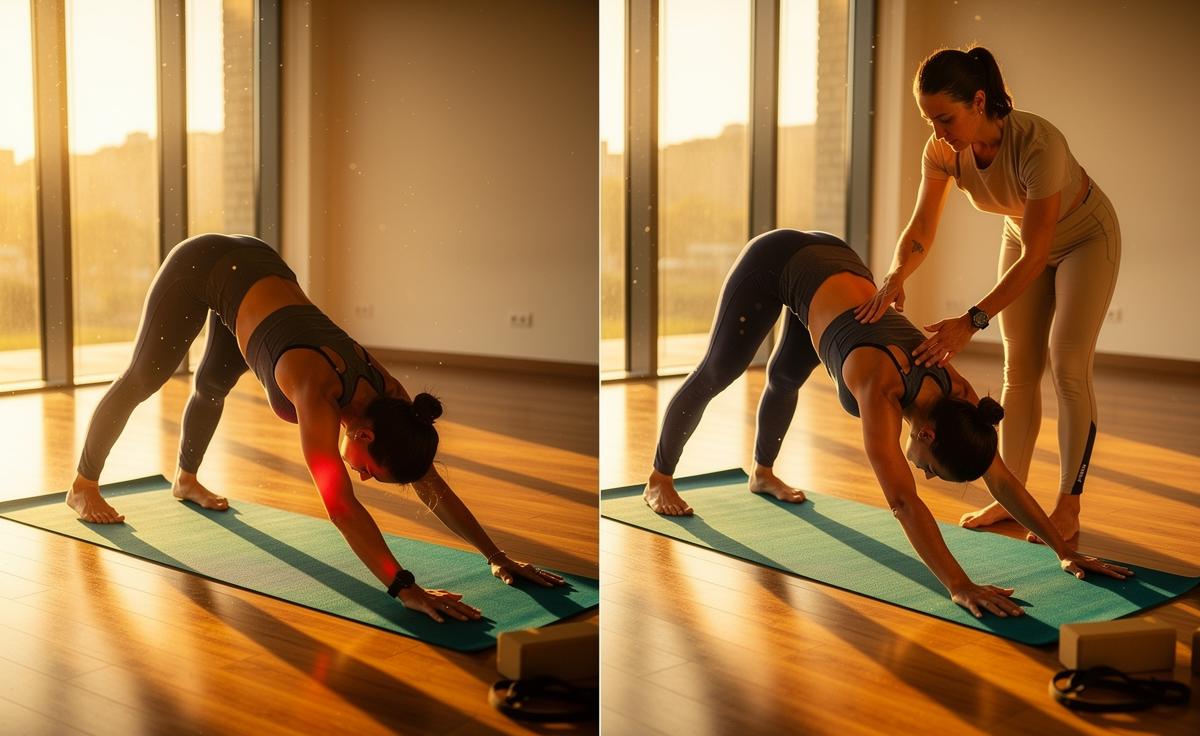
Downward dog, plank, warrior II—these staples are often the scenes of the crime. In downward dog, collapsing into the wrists while rounding the upper back spells shoulder trouble. Press the floor away, rotate elbow creases forward, and bend the knees to lengthen the spine first, hamstrings later. In plank, hips sagging below the line of the body compress the low back. Lift your thighs, zip the lower ribs in, and imagine dragging your toes towards your hands to awaken the front body.
Warrior II tempts overreach. The front knee lurches inside the line of the toes; the back arch shortens and protests. Stack the knee over the middle toes, press the outer edge of the back foot, and lift the arch. If the pose steals your breath, reduce the stance. Small corrections compound into big relief, especially for new practitioners returning from desk-heavy days.
Use this quick-reference table to decode sensations:
| Pose | Pain Signal | Likely Cause | Quick Fix |
|---|---|---|---|
| Downward Dog | Wrist ache, neck strain | Shoulders collapsing forward | Spread fingers, shift weight back, bend knees |
| Plank | Low-back pinch | Hips sagging, ribs flaring | Lift thighs, knit ribs, press heels back |
| Warrior II | Knee pain | Knee collapsing inwards | Track knee over middle toes, shorten stance |
| Forward Fold | Hamstring tug at sit bone | Locking knees, yanking | Micro-bend knees, hinge from hips |
Breath, Bandhas, and Bravado: Hidden Causes of Strain
Breath is the metronome of safe practice. When it stutters, alignment follows. Holding the breath converts yoga into isometric panic. Inhale to create length; exhale to stabilise. If your exhale feels weak in transitions—chaturanga to upward dog, for instance—your load is too big or your tempo too fast. Slow down. Your breath should lead the pose, not chase it.
Then there are the bandhas, or internal locks. Think of gentle tone across the pelvic floor and lower belly as a seatbelt, not a corset. Over-gripping the abdominals can yank the pelvis into posterior tilt, flattening spinal curves and crowding the discs. Under-engaging lets joints wobble and ligaments do the labour. The middle path? Light activation—20 to 30 percent effort—sustained and steady.
Bravado is slipperier. It sneaks in as ambition disguised as discipline. You add a bind because the person beside you did, or chase a backbend after a long run and no warm-up. If your mind is louder than your body, reduce the pose by one degree. Practise steadiness before depth; build competence, then complexity.
Smart Props and Modifications for Every Body
Props are not crutches; they’re amplifiers of intelligence. A block under each hand in forward folds frees the spine and protects the hamstrings. A strap turns unreachable binds into workable shoulder mobility. A folded blanket cushions knees in low lunge and lets the pelvis tip anteriorly in seated poses, easing low-back strain. When in doubt, elevate the floor to meet you.
Tight shoulders? In down dog, loop a strap around upper arms to prevent them from splaying. Tender wrists? Use fists or wedge the heels of the hands on a rolled mat to change the angle. Sensitive lower back? Swap full wheel for supported bridge on blocks, focusing on even breath and glute-hamstring cooperation. These are adjustments, not admissions of defeat.
Modifications also respect daily variability. You might be strong at 7 a.m. and stiff at 7 p.m. A shorter stance, softer knees, or wall support can turn a potentially injurious session into a nourishing one. Consistency grows from meeting your present capacity, not the memory of last month’s best class.
When to Seek Guidance and How to Self-Assess
Good teachers save bodies. If recurring pain persists for a week, or a single pose triggers a predictable zap, book a one-to-one. Bring specifics: where, when, what movement, and what improves it. A skilled instructor will observe patterns you can’t see—foot collapse, rib flare, a subtle head jut—and offer drills that translate immediately into relief. Investing in form early is cheaper than rehabbing later.
Self-assessment matters between classes. Use your phone camera: front, side, back views of your key poses. Are your knees tracking? Is your pelvis level? Can you breathe smoothly through five cycles without facial tension? If not, scale down by one variation or slow the tempo. Track sensations in a quick log: before practice, immediately after, and the next morning. Patterns leap off the page within a fortnight.
Finally, heed medical signals: night pain that wakes you, progressive tingling, swelling, or loss of strength warrants professional healthcare input. Yoga is a brilliant tool, not a universal cure. Multidisciplinary support—teacher, physio, GP—keeps enthusiasm aligned with anatomy and makes the practice sustainable for decades.
Yoga’s promise is clarity, not contortion. When you treat discomfort as data, scale with props, and let the breath set the pace, your practice becomes stronger and safer. Small changes—knee over toes, ribs steady, ego quiet—protect the joints you’ll need for the long haul. Let sensation be your teacher, not your tyrant. What one adjustment will you test in your next session, and how will you know—by breath, by ease, by the morning after—that it worked?
Did you like it?4.4/5 (21)