In a nutshell
- 🗺️ Apply the Bagua map aligned with the main entrance and place beds, desks, and cookers in a command position (see the door, not in line with it) to regulate chi; use targeted tweaks like plants or paired items to energise wealth and relationship zones.
- 🧹 Embrace purposeful possession over extreme minimalism—containment beats constant discipline with baskets and vertical storage; balance identity and calm by curating in pairs and clusters while noting the pros vs. cons of minimalism.
- 💡 Layer light sources and balance the five elements—Wood, Fire, Earth, Metal, Water—to shape mood; avoid mirrors facing the bed, add Earth textures to ground restless rooms, and use a photo contrast test to spot where colour and material need tuning.
- 🏠 Make budget wins: treat the hallway as the home’s “lung,” refresh the doormat, fix latches, add a runner to slow chi; for renters, use removable upgrades like window film, peel-and-stick cork, and fabric panels, plus noise control via door seals and dense rugs.
- 📌 Field-tested UK insights: small, deliberate layout shifts (e.g., a brass tray and a healthy plant in the wealth corner) create tangible calm; apply pragmatic checklists and room-by-room adjustments for 2026-ready, harmonious spaces.
Feng shui is having a quiet renaissance in British homes, not as mysticism, but as a practical toolkit for calmer rooms, better sleep, and friendlier floor plans. In 2026, design is about intention as much as aesthetic: what you place, where you place it, and why it’s there. After visiting flats in London, terraces in Leeds, and new-builds in Milton Keynes, one truth keeps surfacing: small shifts in layout can transform how a space feels. Below, I share field-tested, UK-specific guidance that blends classical Bagua principles with modern constraints—renting rules, tight hallways, and multifunctional rooms—to help your home’s chi flow with purpose.
The 2026 Energy Reset: Bagua Mapping Meets Real UK Homes
The classic Bagua map—a nine-sector energy grid—can be overlaid on any plan by aligning the bottom edge with your home’s main entrance. In UK properties with narrow corridors, that alignment clarifies where to boost wealth, relationships, or health. On a recent Battersea rental refresh, we treated the back-left corner (wealth) with a living plant and a brass tray for keys; within days, the room felt anchored. Start by mapping your entry wall and work clockwise; the Bagua becomes less abstract when you match each sector to a room you actually use.
In 2026, I suggest a pragmatic overlay: your “command positions” (bed, desk, cooker) should see the door without being in its direct line. That reduces startle responses and promotes focus. If the door must face the bed—as in countless UK box rooms—angle the bedside lamp and add a fabric headboard to “catch” energy. Think of furnishings as valves that regulate flow: open pathways, soften hard edges, and ensure your front door opens fully with no shoe pile strangling the threshold.
Use this quick-reference grid to translate Bagua ideas into ordinary rooms without major works. It isn’t dogma; it’s a starting scaffold to guide the next choice you make.
| Bagua Area | Typical UK Room | Helpful Colours/Elements | Quick Fix |
|---|---|---|---|
| Wealth (Back Left) | Lounge corner or office nook | Purple, green; Wood | Healthy plant; wooden tray for bills |
| Fame (Back Centre) | TV wall or mantel | Red; Fire | Warm accent lamp; framed achievement |
| Love (Back Right) | Bedroom side | Pink, cream; Earth | Pairs of items; soft textiles |
| Health (Centre) | Hallway hub | Ochre; Earth | Clear floor; round rug |
| Career (Front Centre) | Entry hall | Black, blue; Water | Doormat refresh; mirror (not facing door) |
Clutter, Chi, and the Psychology of Space: Why Less Isn’t Always Better
Decluttering is a feng shui staple, but the 2026 twist is nuance. Empty rooms are not inherently calm. The goal is purposeful possession—what supports your life stays, what drags your energy goes. In a Manchester maisonette, a client felt “stuck” after a ruthless clear-out; we reintroduced a bookcase and travel photos, and the room regained warmth and identity. Evidence from environmental psychology suggests personal cues can buffer stress and improve a sense of control. Chi thrives on clarity, not sterility.
Try a timed, category-based review: shoes by the door, mugs by the kettle, products by the sink. Rehome, then add a “containment rule”: one attractive basket per category near its point of use. Containment beats constant discipline. Where storage is scarce, think vertical—peg rails in hallways, over-door shelves in utility cupboards, and slim console tables to capture mail before it migrates.
Still, recognise when minimalism works: studio flats, shared houses, and busy family kitchens benefit from visual quiet. The trick is knowing your threshold. Here’s a quick contrast to calibrate your choices.
- Pros of Minimalism: Faster cleaning; less visual noise; cheaper to maintain.
- Cons of Minimalism: Can feel cold; suppresses identity; risks rebound clutter.
- Balanced Alternative: Curate in pairs and clusters; display a few loved items, store the rest.
Light, Colour, and Element Balancing for Every Room
Light is the first currency of chi. North-facing UK rooms often read cool and flat, so layer illumination: a ceiling fixture for general light, a warm reading lamp (2700K), and a directional task light for worktops. Multiple, lower-intensity sources beat a single bright glare. Mirrors can double light, but avoid placing one directly opposite your bed; angled to reflect a plant or art is better. In rentals, clip-on shades and plug-in sconces offer flexibility without drilling.
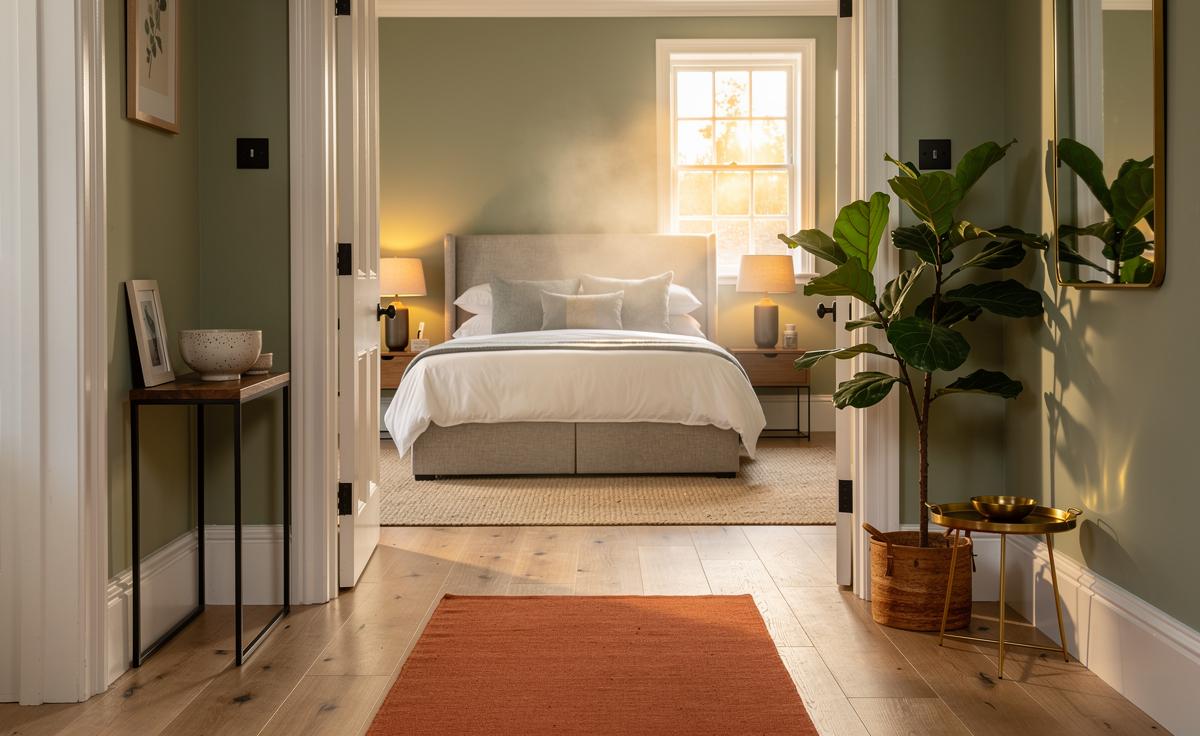
Colour does emotional heavy lifting. The five elements guide a balanced palette: Wood (greens, growth), Fire (reds, passion), Earth (yellows, stability), Metal (whites/greys, clarity), and Water (blues/blacks, flow). In a Leeds semi, a muted sage (Wood) in the dining area improved appetite and conversation; a terracotta runner (Fire) warmed a long, cold corridor. If a room feels restless, add Earth in textures—jute, clay, ochre—to ground it.
For bedrooms, think cocoon: 2700K bulbs, layered curtains to block street light, and zero red LEDs on chargers. In kitchens, energise mornings with brighter task light and crisp whites (Metal) for focus, calming with dimmers after dusk. A simple test: take a photo in black-and-white; if the room reads as a single grey mass, you need contrast—dark frames, pale throws, or a wood bowl to break the monotony and invite attention.
Practical Upgrades on a Budget: From Hallway Qi to Bedroom Calm
Good feng shui is often inexpensive. Your hallway is the lung of the home: upgrade the doormat, fix the sticky latch, and choose a narrower shoe rack so the door opens fully. Place a slender plant or umbrella stand to “catch” energy drifting too quickly down a corridor. In box bedrooms, restore the command position: bedhead on a solid wall, clear view to the door, with nightstands on both sides—even if one is a slim shelf—to signal balance in relationships.
Noise is overlooked chi. In a Bristol flat above a café, we softened clatter with door seals and a dense rug under the sofa; the effect on rest was immediate. For renters, removable wins abound: window film for privacy without killing light, peel-and-stick cork for a mini pinboard (and acoustic absorption), and fabric panels behind the bed for a grounded, hotel-like feel. Think layers: floor, wall, window, and air—each is a lever you can adjust without a renovation.
Try these quick, wallet-friendly tweaks that consistently deliver.
- Under £20: Replace harsh bulbs with warm LEDs; add a fresh doormat.
- Under £50: Pair of matching cushions; fabric headboard cover; over-door hooks.
- Under £100: Dimmable lamp; runner rug to slow corridor chi; blackout liners.
- Weekend project: Paint a single “anchoring” wall; install peg rail; repot two houseplants.
The heart of feng shui in 2026 is not superstition—it’s strategy. When you align layout, light, and personal meaning, rooms stop fighting you and start lifting you. Small, deliberate changes compound into a daily sense of ease. If a principle jars with how you live, bend it until it serves you; the home should reflect your best habits, not shame imperfect ones. Which corner of your home is calling for a reset this month, and what is the first, smallest change you’ll make to invite better flow?
Did you like it?4.3/5 (22)