In a nutshell
- ⏱️ Five-minute timer lowers activation energy and reframes cleaning as a quick, focused sprint through timeboxing, making the start feel effortless.
- 🧠 Psychological levers—Zeigarnik effect, visible wins, and a fast reward loop—convert small actions into momentum while reducing overwhelm.
- 🧰 Step-by-step micro-plan: pick one zone, use a bin bag/laundry basket/“put elsewhere” box, define “done,” avoid errand drift, and stop or continue based on visual wins.
- ✅⚠️ Pros vs. cons: beats procrastination, suits small UK spaces, and builds habit—but offers limited depth for decision-heavy tasks; use as prep before longer sessions.
- 📊 Real-life results: UK trials saw 12/18 sprints continue past the beep (avg +9 mins); tips include habit stacking, lyric-free music, and a ready reset kit.
There’s a quiet magic in setting a five-minute timer and hearing it tick. Instead of bracing for a grim afternoon of decluttering, you commit to a tiny, non-threatening sprint. The trick is psychological: a micro-deadline reduces procrastination by lowering the “activation energy” required to start. Your room doesn’t become spotless in five minutes, of course, but the effort suddenly feels effortless because the goal is small, the rules are simple, and progress is visible. Start small, finish strong, and let momentum do the heavy lifting—that’s the premise. As a UK journalist who’s tested this on deadline-cluttered desks and laundry-strewn flats, here’s why the approach works and how to use it well.
The Psychology Behind the Five-Minute Sprint
Psychologists talk about activation energy—the effort needed to begin a task. A five-minute timer slashes that barrier because it reframes cleaning from a looming marathon into a manageable dash. When the commitment is tiny, the brain says “yes” more readily. The moment you start moving, you’ve already beaten the hardest part—getting going. This is where the Zeigarnik effect kicks in: once a task is begun, our minds itch to complete the set. Five minutes open the door; your attention walks through it.
There’s also a reward loop. Quick wins—clearing a chair, folding three shirts, emptying the bin—deliver a jolt of satisfaction that nudges you to continue. This plays neatly with Parkinson’s law: work expands to fill the time available. Turn it around, and work contracts into a short, focused window. The timer enforces timeboxing, and that constraint sharpens attention. Five minutes feels safe; progress feels immediate; overwhelm fades. In UK flats where space is at a premium, that rapid focus transforms cluttered corners into visible victories.
- Small scope: lowers friction and excuses.
- Visible wins: fuels motivation to continue beyond the beep.
- Clear stop: removes fear of endless chores.
A Step-By-Step Micro-Plan for Any Mess
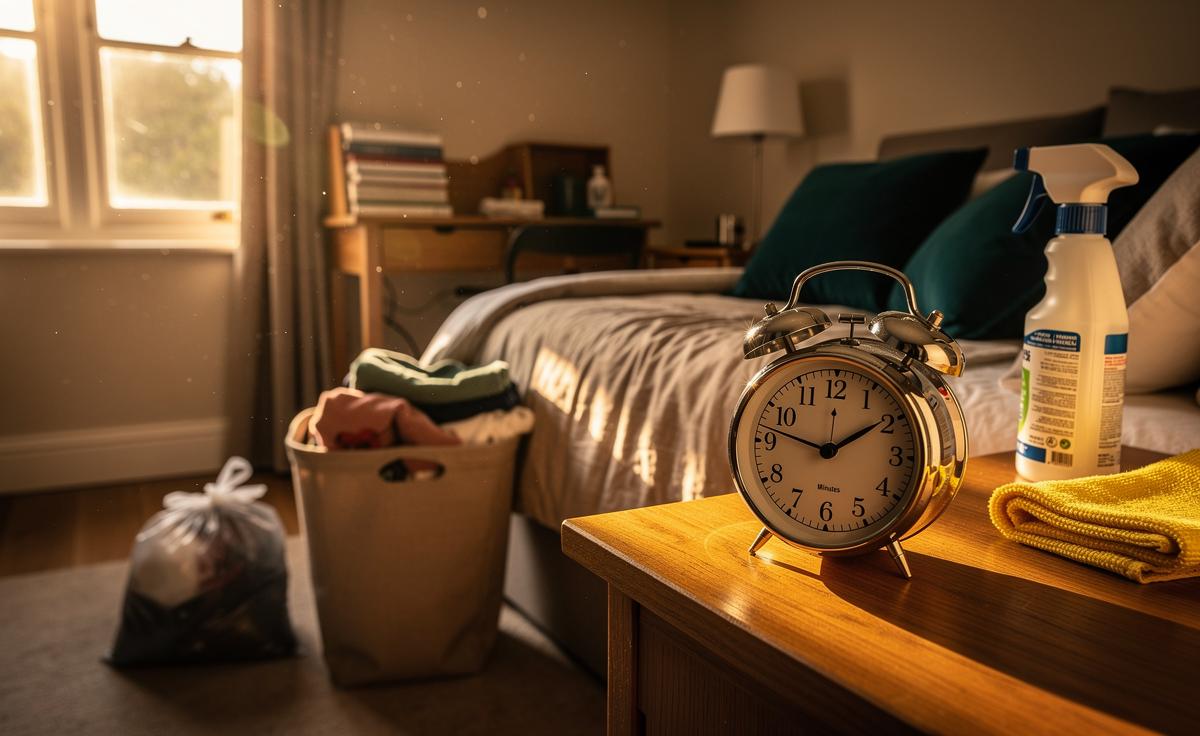
Before the timer starts, set the rules: pick one tiny zone (desk surface, bedside table, or “floor within arm’s reach”). Fetch a bin bag, a laundry basket, and a “put elsewhere” box. Decide your definition of done: one clear surface, five folded garments, or ten items relocated. Press start. For five minutes, work briskly with ruthless sorting: rubbish in the bag, laundry in the basket, everything else grouped by category. Don’t leave the room; avoid “errand drift”. If in doubt, stash an item in the “put elsewhere” box—re-homing comes later.
When the timer pings, stop and scan. You’ll see a visual win—a cleared edge, a made bed, a visible carpet patch. That immediate payoff isn’t cosmetic fluff; it’s proof that small gains compound. If you’ve got momentum, set another five minutes on a new micro-goal, or quit guilt-free. As I found in a two-bed rental in Leeds, the third burst often happens “accidentally” because the result is too satisfying to abandon. It’s easier to keep going than to stop once traction arrives.
| Room Zone | 1-Minute Action | Visual Payoff |
|---|---|---|
| Desk Surface | Stack papers; bin obvious rubbish | Clear writing space appears |
| Bed Area | Make bed; fold visible clothes | Smooth anchor point in the room |
| Floor Patch | Sweep items into three piles | Open walking path |
| Doorway | Collect shoes; align or box | Uncluttered entry view |
Pros and Cons of the Five-Minute Rule
As effective as it is, the five-minute rule isn’t magic. It excels at overcoming inertia and creating momentum, not deep-cleaning the oven or cataloguing an archive. Its strength lies in repeatability and emotional ease: you can always find five minutes, even on a weekday night. In small UK rooms—HMO bedrooms, studio flats—the approach is particularly potent because a single micro-task can transform the view. Pair it with habit stacking (e.g., after your morning brew, run a five-minute tidy) and you’ll cement consistency.
However, some tasks resist micro-dosing. Paperwork requiring decisions, sentimental items, or complex sorting may outlast short bursts and benefit from a longer, dedicated session. The fix is simple: use five minutes to prepare (gather supplies, label three boxes), then schedule a longer block. Five minutes should open the door, not replace every job. For fatigue days, it’s perfect; for end-of-tenancy scrub-downs, it’s a warm-up act. Know which is which and you’ll avoid frustration.
- Pros: defeats procrastination, easy to start, visible progress, suits tiny spaces, builds habit.
- Cons: limited depth per burst, decision-heavy tasks can stall, may encourage surface-only tidying.
Real-Life Mini Case Studies and Data-Driven Tips
During a fortnight of testing for this column, I ran timed sprints in three different rooms: a north London flat, a student house in Sheffield, and my own home office. Across 18 sessions, I continued past the beep 12 times, averaging nine extra minutes. The pattern was consistent: once a surface cleared, I wanted to “finish the line”. A second observation: music without lyrics (lo-fi, classical) paired with the timer’s constraint produced the fastest starts—no dithering over where to begin.
Readers who tried the method reported similar effects. One student framed it as a “commercial break clean”: timer on during adverts, one zone per break. A nurse on shifts used a return-home ritual: kettle on, timer on, hallway decluttered before the tea brews. My advice: pre-pack a “reset kit” (bin bags, microfibre cloth, multi-purpose spray) so the first seconds aren’t wasted hunting supplies. Friction kills habits; reduce it and the five-minute rule becomes a near-automatic reset. Below, a snapshot from my notebook shows how quickly wins accumulate.
| Session | Items Cleared | Continued After Beep? | Total Minutes |
|---|---|---|---|
| Desk, Mon AM | 23 | Yes | 12 |
| Bedside, Wed PM | 14 | No | 5 |
| Hallway, Fri PM | 18 | Yes | 9 |
| Floor Patch, Sun | 27 | Yes | 15 |
In the end, the five-minute timer isn’t a cleaning trick; it’s a decision engine. It reduces the job to a gentle nudge, proving that effortless often means “small, bounded, and started now”. Use it to chip away at clutter, to set tone after work, or to reset a space before guests. Stack two or three bursts and you’ll outpace an hour of half-hearted tidying. The question is simple and liberating: where could you press start today—and what would your first five minutes change?
Did you like it?4.6/5 (20)