In a nutshell
- 🧠 Clutter spikes stress by overloading attention, raising cortisol and decision fatigue; clearing stalled projects reduces attentional residue and restores mental bandwidth.
- 🧰 Use the Four-Pile Method—Keep, Donate, Recycle, Rethink—plus micro-zones to make the right action the easy action; a 30-day default discard date prevents limbo and supports UK-friendly donation/recycling.
- ⚖️ Minimalism isn’t a mandate: aim for right-sizing; apply one-in-one-out, trial boxes, and surface audits to avoid over-purging, regrets, and repurchasing while boosting sustainability.
- 🏠 London flat case study: micro-zones, a “Friday Five” mail rule, and edited storage delivered time saved, money recouped, and lower stress—proof that systems make order stick.
- 🚀 Start small—one drawer, one habit—and build momentum; decluttering works as maintenance engineering for your mind, reducing daily friction and making rooms support real life.
Most of us underestimate how much mental noise is generated by physical mess. Every orphan cable, every “someday” project, and every teetering stack is a quiet demand on your attention. As a UK reporter who’s toured homes from studio flats in Hackney to family terraces in Leeds, I’ve seen how clutter inflates stress and delays action. It isn’t simply untidiness; it’s a constant tax on focus and mood. Decluttering, done thoughtfully, isn’t an aesthetic fad. It’s a proven way to lower the friction of everyday life, reclaim time, and make rooms work harder. Here’s why streamlining your space can unlock calmer days—and how to start without losing what matters.
The Psychology of Clutter and Cortisol
Clutter overloads the brain’s filtering system. When your surfaces and shelves are busy, visual stimuli compete, elevating the sense of being “on alert.” Researchers have linked disordered environments to higher stress markers, while neat environments help the brain conserve energy for meaningful tasks. Decision fatigue rises when you face too many micro-choices—keep or toss, file or pile—until you either procrastinate or capitulate. Mess magnifies mental load by forcing your attention to triage the trivial. That’s why your shoulders drop when a room is reset: you’re reclaiming cognitive bandwidth and lowering background anxiety.
This isn’t an argument for sterile minimalism. It’s about aligning your surroundings with your real life. A family kitchen should display lunchboxes and spices because they’re used daily; the “clutter” is functional. The issue is the attentional residue left by stalled projects and homeless items. When everything has a place, your brain trusts the system. Clarity is not the absence of stuff; it’s the presence of structure. Decluttering becomes a mental health practice because it converts ambiguity into predictable, repeatable order.
Practical Framework: The Four-Pile Method and Micro-Zones
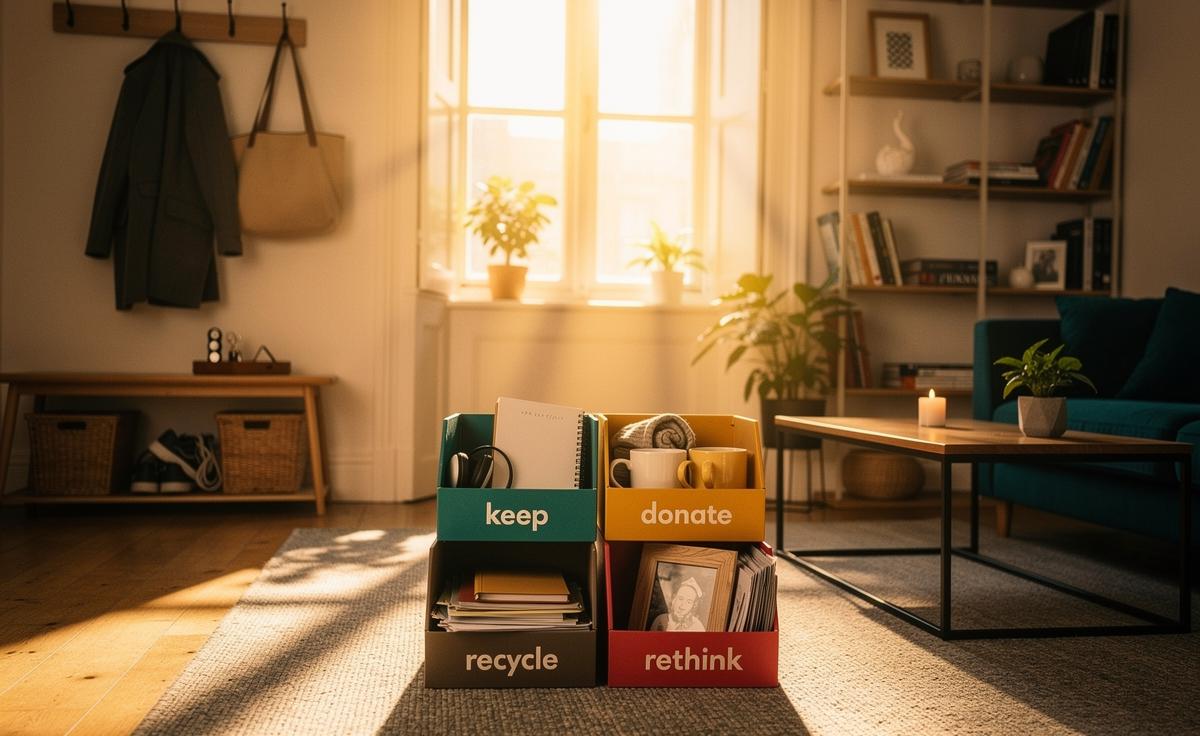
If you dread a marathon clear-out, switch to a sprint model. The Four-Pile Method—Keep, Donate, Recycle, Rethink—limits decision points and builds momentum. Start where success is obvious (bathroom drawers or the mug glut) to bank quick wins. “Rethink” is your parking bay: items with emotional tug or uncertain usefulness rest there for 30 days with a default discard date. That single rule prevents endless limbo. In UK homes, funnel “Donate” to local charity shops, use council recycling streams, and photograph sentimental pieces before letting them go—memory kept, volume reduced.
Next, carve micro-zones—tiny, purpose-led stations that pre-empt mess. Post, keys, school kits, pet gear: each gets a tray, hook, or basket within arm’s reach of where the activity starts. Micro-zones shrink the distance between “use” and “return,” the crucial behaviour change that keeps order sticking. Make the right action the easy action: a labelled lidded box for cables near the sockets, not across the room; a shallow basket for remotes, not the coffee table’s far edge. Measured in minutes saved, this is decluttering’s highest ROI.
- Keep: Items used weekly with a clear home.
- Donate: Good-condition duplicates and “someday” items.
- Recycle: Paper piles, expired toiletries, worn textiles.
- Rethink: Emotional or ambiguous items with a 30-day review.
Pros vs. Cons of Minimalism: Why Less Isn’t Always Better
Minimalism promises focus, but it’s a tool, not a destination. Done well, it reduces noise, speeds cleaning, and clarifies taste. Done dogmatically, it can erase personality, introduce replacement waste, and ignore accessibility needs. The goal is right-sizing: calibrating possessions to your routines. Parents may need “abundant minimalism”—fewer categories, not fewer toys. Crafters may keep generous supplies, but corral them by project. Less is powerful when it serves life; less is punishing when life must serve it. Think in terms of friction: keep what lowers friction, release what raises it.
To choose wisely, test interventions, not ideologies. Pack a “trial box” of rarely used items; if nothing is retrieved in 60 days, release them. Use a one-in-one-out rule for categories that sprawl (t-shirts, food containers). Audit surfaces weekly: anything living there without a task gets reassigned. Crucially, don’t purge to later panic-buy—measure first. Sustainability sits in the middle: reuse, repair, then responsibly rehome. The aim is a home that breathes and supports you, not a gallery that scolds you.
| Pros | Cons |
|---|---|
| Fewer choices reduce decision fatigue. | Over-purging can trigger regret and repurchasing. |
| Faster cleaning and easier maintenance. | Spaces may feel sterile or impersonal. |
| Financial clarity curbs impulse buys. | Strict rules can ignore accessibility or hobbies. |
| Better focus for work and rest. | Social pressure to “perform” minimalism. |
Case Study: A London Flat Transformation
In a one-bed in Walthamstow, a couple working hybrid schedules felt constantly “behind.” We mapped where mess started: post piling by the door, gym kit migrating to the sofa, and a kitchen “doom drawer.” In three 45-minute sessions, we deployed micro-zones and the Four-Pile Method. The doom drawer became two shallow trays—tools and household admin—labelled and purged of expired batteries. A wall-mounted letter rack caught post with a weekly Friday Five rule: five minutes to triage. The sofa got a narrow bench with cubbies for gym kit, replacing the floor as storage.
Results were immediate and measurable. They reported saving “about 10 minutes every morning” not hunting for keys or headphones. Nine bags went to the local charity shop; two duplicate appliances were sold online, funding a compact bookshelf. The home began to say yes to their lives—yes to quick breakfasts, yes to quiet reading, yes to guests without a flurry. A month on, the system held because every item had a natural landing pad and a return path. That is the crux: decluttering is maintenance engineering for your mind.
- Time saved: Shorter morning routines and quicker resets.
- Money recouped: Selling duplicates paid for better storage.
- Stress reduced: Fewer urgent hunts, more predictable rhythms.
Decluttering isn’t about perfection; it’s about designing a home that absorbs life’s bumps without squeaking. When your space stops arguing with you, your day gets quieter: surfaces invite action, routines click, and decisions take less energy. Think of it as editing, not erasing. Begin with one shelf, one drawer, one habit; let momentum, not willpower, do the heavy lifting. As rooms become simpler, your priorities grow louder in the best possible way. What single micro-zone or rule—today, this hour—could you introduce to make tomorrow noticeably easier?
Did you like it?4.5/5 (24)