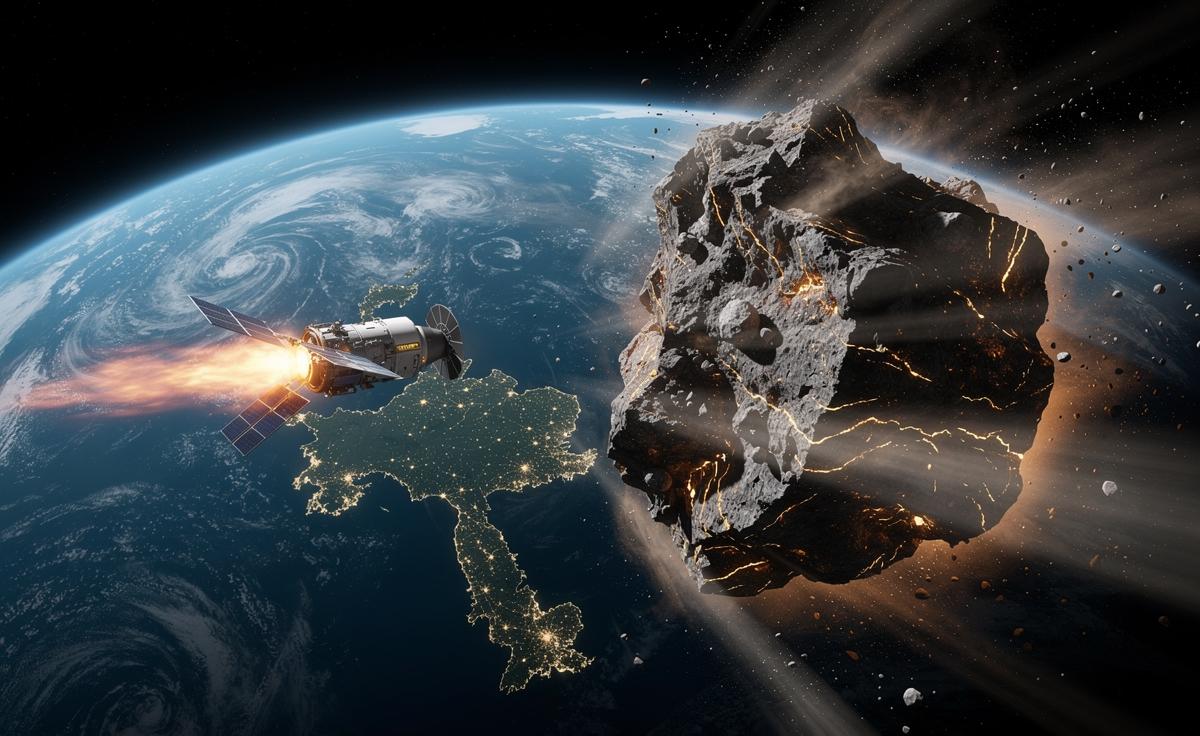
Tonight, a sentence many hoped never to hear became official: NASA has confirmed that a newly tracked near-Earth asteroid sits on a collision course with our planet. The timeline is measured in years, not hours; however, the implications cut across science, policy, and everyday life. For the UK, this is a test of resilience as much as a test of rockets. This is not a doomsday proclamation. It is a call for clear heads and practical, timely action. Officials stress there is time to act, not to panic. In the coming days, expect briefings, new data, and—crucially—credible guidance that turns anxiety into preparation.
What NASA Confirmed and What It Means
Words matter, and in orbital mechanics, so do percentages. When NASA scientists say an asteroid is on a “collision course”, they mean that current orbital solutions—the best-fit paths derived from repeated telescope observations—converge on Earth at a future date unless a deflection changes that outcome. The CNEOS Sentry-II system at JPL continuously refines these solutions as fresh measurements tighten the error bars. Early figures can look alarming. They evolve. Expect radar ranging, thermal measurements, and an international observing campaign to sharpen the picture rapidly. The solution set will evolve with every new observation. That’s how science works, and it’s why calm beats conjecture.
Risk communication uses two scales. The Torino Scale translates hazard into a 0–10 public score; the Palermo Scale compares risk against the background rate of impacts. Neither is a crystal ball. Both will adjust as the observation arc lengthens. If the object remains on an impact trajectory, actionable timelines become the central question: launch windows for deflection missions, evacuation and continuity planning horizons, and supply-chain lead times. Behind the scenes, NASA, the ESA, and national agencies—including the UK Space Agency—are already synchronising models, assets, and messaging so the public hears one clear voice.
| Metric | Current Assessment |
|---|---|
| Designation | Provisional; public release pending orbit refinement |
| Estimated Diameter | Approximately 300–600 metres (subject to revision) |
| Approach Speed at Earth | Roughly 20–25 km/s |
| Potential Impact Window | Years, not weeks; detailed dates to follow from NASA/JPL |
| Risk Scales | Torino: low single digits; Palermo: below zero but rising with data |
| Lead Agencies | NASA CNEOS, JPL, ESA Planetary Defence Office, UK Space Agency |
The Science and Strategy of Planetary Defense
Deflection, not detonation, is the watchword of modern planetary defense. The proof-of-principle came with DART, which altered the orbit of the asteroid moonlet Dimorphos by ramming it at high speed. The physics was elegant: momentum transfer multiplied by ejecta plume effects. The next step, the ESA’s Hera mission, will quantify that change and calibrate models. With years of warning, a series of kinetic impactors could nudge a threatening asteroid off target by tiny degrees that translate into thousands of kilometres at Earth’s distance. Time is the decisive variable. Every month gained increases the menu of safe options.
Alternatives exist. A gravity tractor—a spacecraft hovering nearby—uses sheer mass and patience to tug an asteroid’s path. Laser ablation and targeted surface heating are being studied for smaller bodies or fine-tuning. Nuclear devices, the dramatic last resort, are reserved for short-warning, large-object scenarios under strict international oversight. Each method demands precise knowledge of the asteroid’s composition: rubble pile or monolith, porous or metallic, spinning fast or tumbling. Enter new space telescopes, radar arrays, and thermal infrared measurements. Together, they shrink uncertainties, widen the deflection window, and transform dread into engineering. That’s the plan. That’s the hope. And it’s credible.
UK Readiness: Government, Science, and Community
In Whitehall, the choreography starts now. The Cabinet Office will convene COBR meetings, aligning the UK Space Agency, the Department for Science, Innovation and Technology, the Met Office, and emergency services. Scenario exercises—already practised for floods and pandemics—pivot to impact modelling: overland shockwaves, tsunamis from a splashdown, or high-altitude airbursts. The aim is not drama. It is continuity: power, water, healthcare, communications. Preparedness is a civic habit, not a single act. Expect a tiered public information campaign that distinguishes global mitigation (deflection missions) from local resilience (household readiness and community response).
British science will be at the forefront. Universities and observatories will feed astrometry to global networks. Supercomputers will refine impact corridors with ensembles, reflecting uncertainty transparently. The Royal Observatory and learned societies will translate jargon into sense, helping journalists and citizens parse risk without sensationalism. Local Resilience Forums will assess regional vulnerabilities and map evacuation routes where appropriate, while NHS planners model surge capacity and mental health support. Faith groups, charities, and volunteer networks will organise mutual aid. In short: a whole-of-society posture. It’s sober, not spartan. It’s grounded in evidence. And it’s already part of the UK’s civil contingencies doctrine.
Practical Steps You Can Take Today
Start simple. Information hygiene first: follow NASA, ESA, and the UK government’s official channels; mute rumour mills. Create a family communication plan with two out-of-area contacts, a meeting point, and a hard-copy list of numbers. Build a modest resilience kit: water for three days, non-perishable food, first-aid, medications, a torch, batteries, power bank, and copies of essential documents. Keep cash on hand. Back up photos and records. These are low-cost, high-utility steps that help in any emergency, asteroid or otherwise. Preparedness reduces fear because it replaces the unknown with a checklist you control.
Think local. Identify community assets—neighbours with medical skills, tools, or generators—and gently knit a support network. Check your insurance, understand rental or mortgage protections, and review workplace continuity plans. If you live near a coastline, learn your council’s evacuation signage and routes; if inland, locate sturdy shelters and transport nodes. Parents: practise a calm drill with children; normalise the plan. Older adults and those with disabilities may need tailored kits and buddy systems. Finally, plan for the mind: limit doomscrolling, schedule breaks, and use reputable mental health resources. Small steps, done early, add up to resilience when it counts.
The announcement lands like a thud, yet it need not paralyse us. The world has a plan—and time—to bend physics in our favour, provided we act with clarity and coordination. Scientists will aim; engineers will build; responders will prepare; communities will look out for one another. Our job as citizens is straightforward: stay informed, stay kind, stay ready. Preparation is power, and it is shared. As new data arrives and missions take shape, what role will you choose—observer, organiser, or advocate—to help your street, your town, and your country meet this moment?
Did you like it?4.7/5 (20)