In a nutshell
- 🌊 Discovery of a vast subglacial river–lake network beneath Antarctica, revealing active hydrology that shapes ice flow, heat distribution, and the global carbon cycle.
- 🧫 Identification of thriving chemosynthetic microbes, including efficient methanotrophs that curb methane emissions and hydrogen-fuelled communities acting as a carbon brake.
- 🔬 Robust verification via clean drilling, in situ redox sensors, metagenomics, isotopic tracing, and radar/seismic imaging—multiple independent lines of proof.
- ⚙️ Isolation of cold-active enzymes with industrial promise—enabling lower-temperature recycling, energy-sipping bioreactors, and effective cold-wash detergents.
- 🌍 Major implications for sea-level rise forecasts and policy, prompting stronger Antarctic Treaty protections, year-round observatories, and international data sharing.
Antarctica is often framed as a blank, frozen stillness. It isn’t. Beneath kilometres of ice a restless world hums with activity, and scientists have just opened a door onto it. In a remote drill site, an international team tapped a long-sealed subglacial lake and intercepted a buried river network that stretches like capillaries under the continent. Water moves. Gases flow. Microbes feast. The implications are immediate, from climate modelling to industrial chemistry. This is not a curiosity; it is a living system with global reach. In a continent famed for extremes, the discovery lands as a measured shock, the sort that forces policy planners, energy strategists, and glaciologists to compare notes fast.
Beneath the Ice: Rivers, Lakes, and Living Chemistry
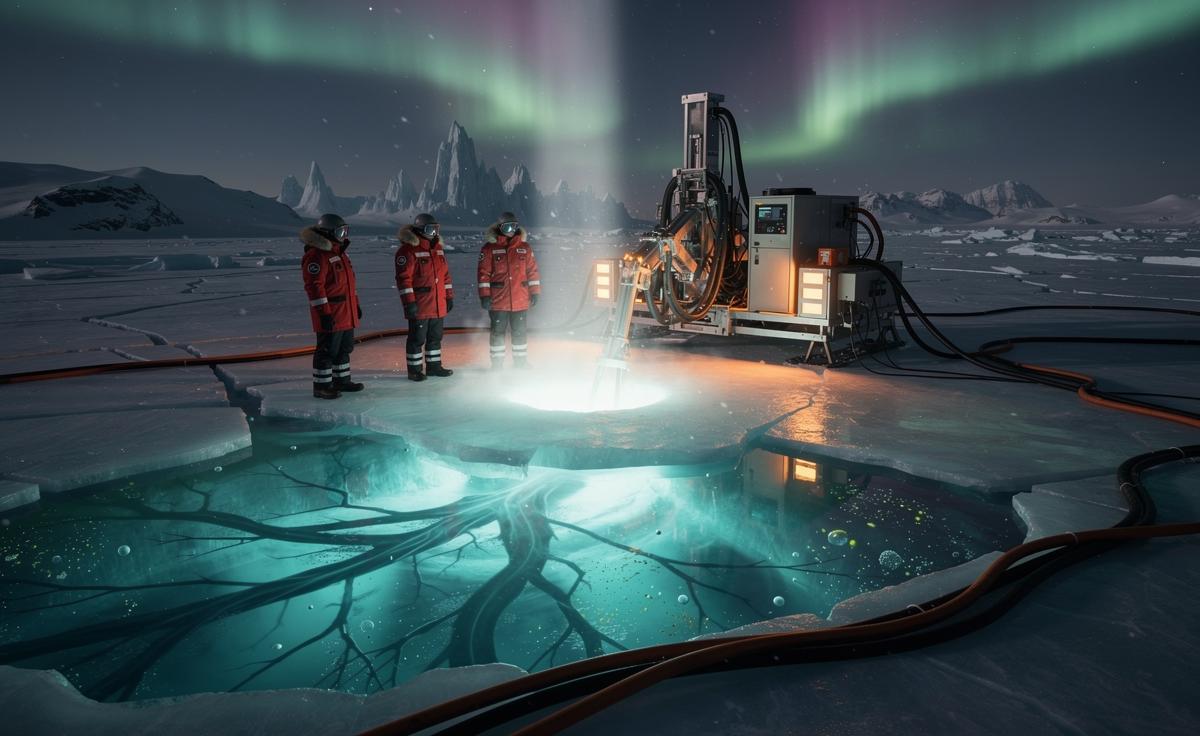
Picture a dark aquifer the size of countries, threaded with subglacial rivers and punctuated by pressurised lakes. That is what ground-penetrating radar, seismic surveys, and a hot-water drill have revealed, along with a trickle of liquid that never sees sun yet shapes the world above. The water is laced with dissolved minerals and gases released as ice grinds bedrock to flour. It is not sterile. It is busy.
Sampling lines ferried water and sediment into sterile bags, then straight into field labs. Results were startling: chemosynthetic microbes thriving at temperatures below zero, using energy not from light but from rock-ice reactions. Hydrogen bubbles from crushed minerals. Methane seeps from ancient organic matter. The microbes make a living on both. This hidden plumbing controls how fast ice slides, where heat accumulates, and how carbon is stored or released. In short, the basement of Antarctica is far from inert; it is a regulator.
Methane, Hydrogen, and a Surprise Carbon Brake
Methane is a potent greenhouse gas. One fear has been a slow, invisible burp from polar sediments as the world warms. The team’s assays suggest a twist: dense communities of methanotrophs—bacteria that oxidise methane—are intercepting part of that flux before it reaches the ocean or atmosphere. They run on chemical gradients, not sunlight, and they are very efficient at low temperatures.
Hydrogen matters too. Generated by water-rock reactions under pressure, it provides a steady power supply that can support life even when nutrient levels crash. That baseline energy, the data indicate, helps stabilise the ecosystem through lean times and sustains a deep carbon cycle under the ice. Antarctica is not merely a carbon source waiting to thaw; in places, it behaves like a brake on emissions. This doesn’t cancel sea-level risk, but it does refine our global carbon arithmetic—and changes where mitigation and monitoring should focus.
Instruments and Proof: How the Team Verified the Find
Scepticism is healthy. The scientists anticipated it. They used clean drilling protocols, triple blanks, and multi-instrument confirmation to build an airtight case. In situ sensors measured redox gradients and temperature as the borehole descended. Back at camp, portable metagenomics sequencers mapped DNA, while mass spectrometers traced isotopic fingerprints proving biological methane consumption rather than simple physical loss.
They also tracked flow speeds by injecting harmless tracers and watching them move through the basal water network. Seismic shots mapped cavities, while radar traced channels linking lake to lake. Independent lines of evidence converged on the same story: a connected hydrological network and an active microbial factory. To keep it clear, here are the headlines from the field notebook.
| Finding | Method | Why It Matters |
|---|---|---|
| Active methane oxidation | Isotopic mass spectrometry | Reduces net greenhouse potential |
| Hydrogen-rich waters | Electrochemical sensors | Supports chemosynthetic life year-round |
| Connected river-lake network | Radar and seismic imaging | Controls ice flow and melt pathways |
| Cold-adapted enzymes | Metagenomics and screening | Potential for low-energy industry |
From Ice to Industry: Cold Enzymes and New Low-Energy Pathways
One strand of the discovery points directly at factories thousands of miles away. The team recovered sequences coding for cold-active enzymes that break down complex polymers and lipids at temperatures close to freezing. In tests, these biocatalysts turned viscous feedstocks into useful intermediates without the heat-hungry steps common in today’s plants. Think recycling at lower temperatures, detergents that work in cold washes, and bioreactors that sip, not gulp, electricity.
There is a sustainability thread here too. Cold-adapted catalysts could slash industrial energy demand and lower costs for regions reliant on renewables with variable output. The Antarctic subterranean biome is offering a blueprint for cleaner chemistry without the penalty of heat. Patience is required—regulation, scale-up, and safeguards all ahead—but the proof-of-concept is in hand. And it arrived in meltwater from a continent most of us will never see.
Sea-Level Forecasts, Policy Shifts, and the Next Antarctic Decade
Hydrology under ice decides how quickly glaciers slide to the sea. By charting channels and lakes, modellers can update sea-level rise projections and sharpen timelines for vulnerable coasts. Some routes lubricate ice streams; others trap and refreeze water, buttressing the ice sheet. The same network ferries carbon and nutrients to the Southern Ocean, nudging ecosystems and climate feedbacks.
Policy is already catching up. Scientists urge expanded protected zones under the Antarctic Treaty, stricter biosecurity to avoid contaminating unique ecosystems, and funding for year-round observatories. We now know the basement plumbing matters as much as the surface snowfall. That means better satellites, smarter sensors, and international data sharing. The take-home? This is a rare moment where discovery, risk management, and opportunity align—and hesitating would be costly.
Antarctica has never been just ice and wind; it is circuitry, chemistry, and quiet biological ambition. The latest findings turn a blank space on the map into a driver of climate, a source of low-energy innovation, and a test of global stewardship. We have found a living engine where many expected silence. The question now is not whether it matters, but how fast we can learn from it without breaking what makes it precious. If this is the start of an Antarctic decade, what should the world prioritise first?
Did you like it?4.6/5 (28)